
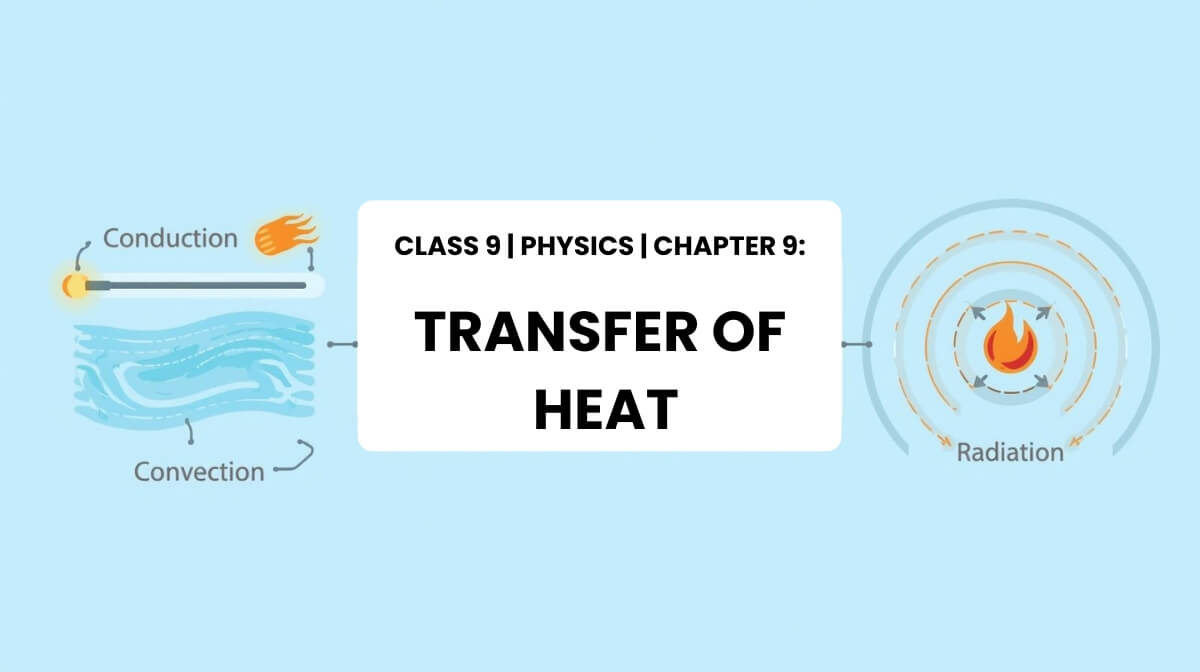
Transfer of heat explains how thermal energy moves from one body to another. This chapter covers the three methods of heat transfer: conduction, convection, and radiation. It also discusses good and bad conductors, thermal insulation, and real-life applications such as thermos flasks and cooling systems. The MCQs below will help students test and reinforce their understanding of these important concepts.
1. Which method of heat transfer occurs without the movement of matter?
- A. Conduction ✅
- B. Convection
- C. Radiation
- D. Evaporation
Explanation: Conduction transfers heat through direct contact without movement of the medium.
2. In convection, heat is transferred by:
- A. Movement of fluids ✅
- B. Direct contact
- C. Electromagnetic waves
- D. Sound waves
Explanation: Convection involves the bulk movement of liquids or gases to transfer heat.
3. Which method of heat transfer can occur in a vacuum?
- A. Radiation ✅
- B. Conduction
- C. Convection
- D. All of the above
Explanation: Radiation transfers heat through electromagnetic waves and does not require a medium.
4. Metals are good conductors of heat because they have:
- A. Free electrons ✅
- B. High density
- C. Large atoms
- D. Low melting points
Explanation: Free electrons in metals quickly transfer energy between particles.
5. Which surface is the best absorber of heat radiation?
- A. Black and dull ✅
- B. White and shiny
- C. Silver and smooth
- D. Transparent
Explanation: Dark, dull surfaces absorb more heat radiation than light, shiny surfaces.
6. The fluid motion caused by temperature differences in a liquid or gas is called:
- A. Convection current ✅
- B. Thermal radiation
- C. Conduction flow
- D. Heat wave
Explanation: Convection currents circulate due to density changes caused by heating.
7. The silver coating inside a thermos flask reduces heat loss by:
- A. Radiation ✅
- B. Convection
- C. Conduction
- D. Evaporation
Explanation: Shiny surfaces reflect heat radiation, reducing heat loss.
8. Which is the poorest conductor of heat?
- A. Wood ✅
- B. Copper
- C. Aluminium
- D. Iron
Explanation: Wood has low thermal conductivity and acts as an insulator.
9. Sea breezes are caused by:
- A. Convection ✅
- B. Conduction
- C. Radiation
- D. Reflection
Explanation: Uneven heating of land and sea causes convection currents that create breezes.
10. Which material is often used for thermal insulation?
- A. Glass wool ✅
- B. Steel
- C. Aluminium
- D. Copper
Explanation: Glass wool traps air and reduces heat transfer, making it a good insulator.
11. The greenhouse effect is an example of heat transfer by:
- A. Radiation ✅
- B. Conduction
- C. Convection
- D. Reflection
Explanation: Radiation from the sun enters, but heat is trapped by greenhouse gases.
12. Which colour of clothing is best to wear in summer?
- A. White ✅
- B. Black
- C. Dark blue
- D. Red
Explanation: White clothing reflects most heat radiation, keeping the body cooler.
13. In conduction, heat is transferred by:
- A. Particle-to-particle contact ✅
- B. Bulk movement of matter
- C. Electromagnetic waves
- D. Phase change
Explanation: In solids, conduction occurs by vibrations and collisions of particles.
14. The main method of heat transfer from the Sun to Earth is:
- A. Radiation ✅
- B. Convection
- C. Conduction
- D. Diffusion
Explanation: Radiation can travel through the vacuum of space from the Sun to Earth.
15. Why are cooking pots often made with copper bases?
- A. Copper is a good conductor of heat ✅
- B. Copper is a good insulator
- C. Copper is lightweight
- D. Copper has low melting point
Explanation: Copper conducts heat evenly, improving cooking efficiency.